Ana Rebeca is my friend. She is an artist. A self-described artist by passion, teacher by profession. Mature for her age, and determined to break the “typical Dominican” mold, she marches to the beat of her own drum. Though she is Santo Domingo-born (and raised), something in Ana Rebeca screams of worldly, of a culture beyond the hustle and bustle of the city, and the culture of merengue, platano, and the family-oriented, strong-willed and always lively Dominican. She’s a critical thinker, studious -- not unlike other Dominicans -- yet she's resistant of many a young Dominican’s focus on big spending, frivolous gossip and the dress-to-impress mindset. She is not mild mannered, still incredibly pleasant. She is colorful, and happy, and she is free of cultural stereotypes and social restrictions. She is free.
On a recent visit to my hometown Ana Rebeca swung by my apartment on an unusually calm Saturday afternoon. She had volunteered to take me to one of her favorite places in the city: La Zona Colonial. This is the colonial era, historical part of the city, the birthplace of the sprawling metropolis that is now Santo Domingo. This is where tourists go to take guided tours, to learn about Christopher Columbus (or Cristobal Colon, as we Spanish speakers call him), and the early Caribbean church. This is the alternative to the beaches, the “wild” Dominican parties, to horseback riding not too far from the safe edges of Dominican Republic’s famed all-inclusive resorts, and a change of scene from white-water rafting on the interior part of the country’s gorgeous rivers. It isn’t off the grid at all. It’s just the other part of Dominican Republic the tourism industry sells you, should you crave a little history on your Caribbean getaway.
Most people go to La Zona Colonial by day. Well, most tourists go by day. And to be truthful, most locals go by night (for the club scene), which is why when I got into Ana Rebeca’s car that day I wondered, but didn’t ask, what it was that we could possibly enjoy at La Zona Colonial by day that we hadn’t already explored in any number of field trips there as youths. I indirectly expressed my confusion, and Ana Rebeca, I remember, beamed with excitement. She said she would be taking me to one of her favorite places in the city. That explanation sufficed.
La Zona Colonial is a beautiful area, and carefully maintained by the city government. It is a gem, and I have honestly treasured it, or at least a memory of it, from early childhood. When I was six my mother worked in one of the restored colonial forts in the area, by the port, at an architectural firm. I remember feeling so small and insignificant walking between those immense stone walls that formed the damp hallways that led to my mother’s office. In that memory I’m wearing a beautiful white dress, lacy and puffed up like most little girls in the early 90s had in their repertoire. The port is by the city's infamous Ozama River. Fall in there and your hand will most likely melt off (not really), from all the refuse and waste discarded there by uneducated citizens, literally ignorant of the consequence of a river polluted by human waste. The result is catastrophically nuclear, not to mention the reason behind the river’s terrible stench. But the port is at the far edge of La Zona Colonial, away from the tourist area.
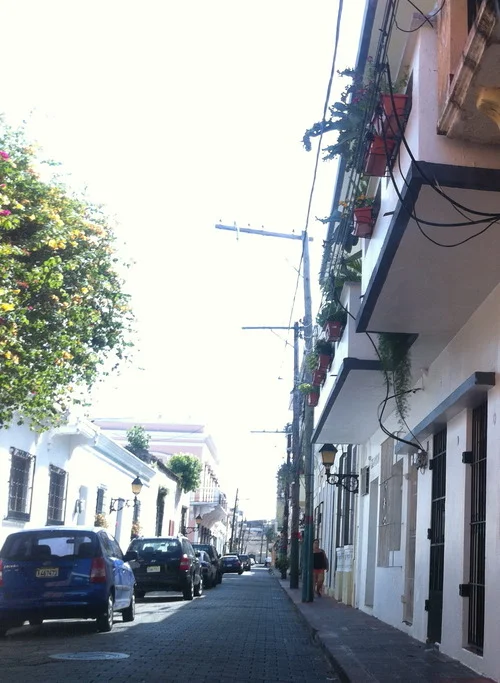
Having traversed much of the contemporary city (Santo Domingo West), I knew we were getting closer to La Zona, as the larger, wider, more modern streets of the city faded into Ana’s rear view mirror. The streets got narrower, cobblestone began to caress the wheels of Ana’s silver Nissan. Upright wheelbarrows started to become sparse. No longer were there street vendors selling sunglasses, car chargers, peanuts, or mangoes. Cars rarely honked here, and there were fewer of them. Motorcycles rarely buzzed by with 2-4 people on board, as in the rest of the city. I heard birds chirping. No high rises here; nothing above 3 stories. No spaces between the tiny houses. It was much quieter there. Often times when I’ve thought of La Zona Colonial I’ve thought of El Museo del Jamon and other "touristy" restaurants in the popular square in front of Alcazar de Colon (Columbus’ house), and of El Conde (a long avenue of stores for the traveling shop-a-holic). Somehow I always forget the charm, the quaintness of the part of La Zona hidden in the side streets of my city’s colonial haven.
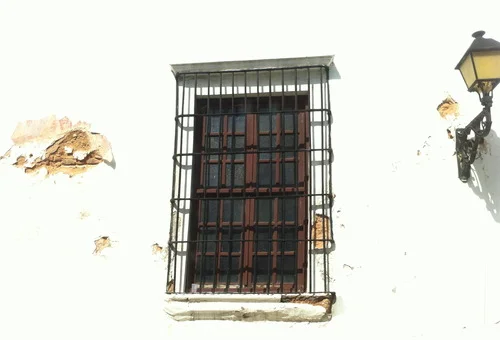
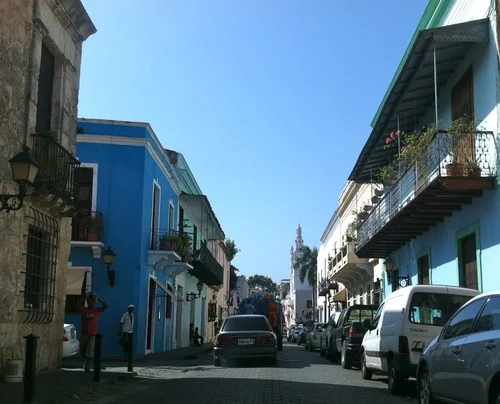
The more we delved into the heart of La Zona Colonial the more simple, pastel colored houses appeared in welcome to a world forged by Christopher Columbus, his son and other colonizers after him. It reverberated the life of Santo Domingo before modernization, before capitalism, before technology drowned out simplicity and the concept of "New World".
The balconies, with their flowers of pink, white and lilac were not unlike small postcard towns in Italy or Spain, but still, they were purely Dominican. I’d never explored this area on a field trip. I felt myself begin to morph. I became a tourist. I whipped out my iPhone, begged Ana to slow down, and snapped away at houses where famous Dominican writers like Salome Ureña and Pedro Henriquez Ureña could have easily lived and written their masterpieces. How could I have forgotten?
All this and we hadn’t even arrived at Ana Rebeca’s favorite place.
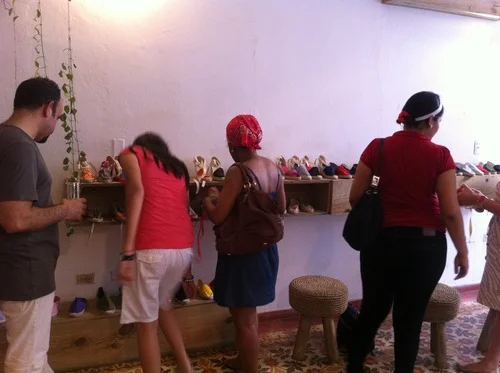
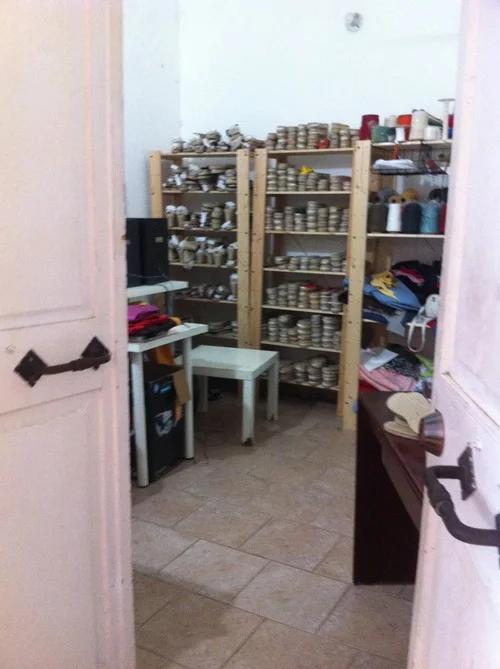
“Here we are. La Alpargateria,” she said. “Alparga-what?”, I asked. She laughed and explained it was part hand-crafted shoe store, part art gallery and part cafe (in that order), and unconventionally open from 4 pm to 11. La Alpargateria’s first room coming in from the street displays handmade canvas shoes on shelves on the right and to the left the man who makes them, at his workstation surrounded by thread and different color fabrics. I wanted to ask how he felt about doing this for a living. Did it feel incredible to express his art in such a historic place, with no limitations as to what to create? But I didn’t ask. Why ruin the experience? Why push away the possibility of an artist’s dream life attained because of any mundane answer he might give, perhaps fueled by exhaustion or the heat.
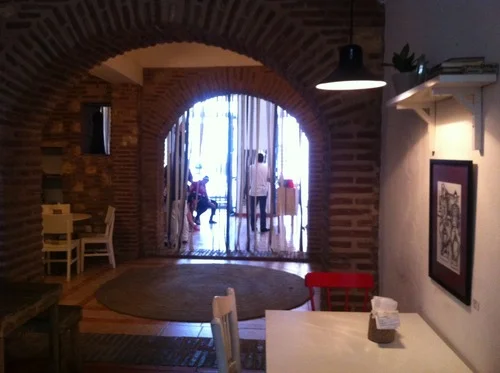
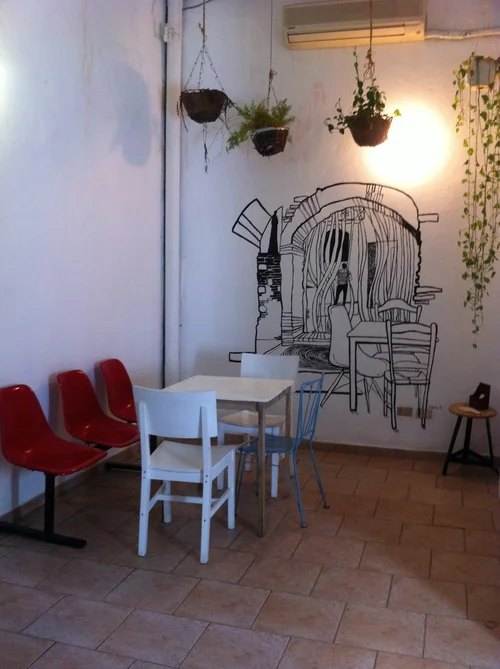
Going further into the art gallery and bar area, my eyes explored the walls, examining each mural. We ventured inwards, and the cooler the walls, the dimmer the colors, the less Caribbean things felt. The bar area was purposefully not well-kept. Rusty door handles, non-matching cups and silverware sat atop a disorderly counter. Brick arches separated each seating area, slash artistic display area. This place was meant to feel disorderly and in that way homey and truly bohemian. Motown music was filtering in from the speakers, softly and unimposing. Soon a new style of music came on.
“Kings of Convenience,” Ana said in almost perfect English. “Huh?,” I asked, completely distracted. “The name of the band. It’s Kings of Convenience.” How in the world does she know, I wondered. Then again, I thought, I know about Al Green, and The Bee Gees, and Abba and all kinds of bands I shouldn’t be aware because of my nationality and my age.
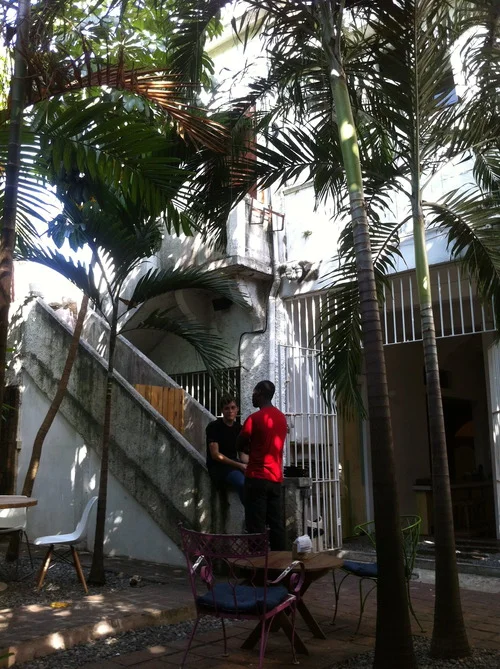
Ana Rebeca started describing the place for me. She defined it as a place for hipsters. Then she paused and admitted she didn’t quite know what a hipster was, other than someone who dresses in skinny jeans and listens to indie music. Knowing there was no need to search for the right words in a place screaming with hipster personality, with my gaze I led her to see the man-boy with scraggly blond curls, a tight black tee, skinny jeans and denim keds. There. That’s a hipster. He couldn’t be more than 19 or 20 but already seemed to carry the laissez-fare, “life is a drag” attitude of someone nearing 23. Not yet professional, not yet suit, but resisting with every fiber of his being. He didn’t notice our observing him but instead leaned lazily on the stairs, staring off into nothing and occasionally at his phone, waiting for something to happen ... who knows what.
We made it past the bar area and art gallery and outside onto the patio to find we were the only patrons at the cafe. The patio was just as cool and thankfully the owners had left many of the signature Dominican palm trees in place. The low, wooden seats (which looked more like box crates) with green, orange and purple cushions were surprisingly inviting. I thanked Ana for bringing me there. It all felt so ... peaceful. I told her so. “It is, isn’t it?” Ana said, taking it all in. “Yes, that’s why I love it here.”
The blond man-boy and another server then stood directly in front of us for quite some time, chatting, staring, waiting for us to settle in so they could take our order. There was no menu, so when blondie came by to ask what we wanted I had to quickly recollect what kind of coffee I liked without a Starbucks board to peruse, which was perfectly fine, perfectly bohemian.
Sitting there enjoying the fresh breeze under the shade of those trees with world music playing in the background, I felt myself forget where I was for a moment. I could've been anywhere. Buenos Aires, Paris or Berlin.
Ana Rebeca and I started talking about our desire to live happily as artists, and only that. Ana Rebeca mentioned how La Zona Colonial would be an ideal area to live in as an artist in Santo Domingo. She could get any old job here and give back to the community through art classes. I could live here too, I said. Just give me a house with a balcony and easy income and I’d spend my afternoons on this patio, writing until my hands tire. The bustling Santo Domingo of the everyday seemed a million miles away at that point.
Eventually Ana Rebeca looked at her watch and realized if we didn’t leave now she’d be late for a church activity in the evening, and she still had to pick up her mom at the salon, which we did. Her mom had rollers in her hair when she stepped in the car. She didn't care.
A Zooey Deschanel song (from her She & Him days) played as Ana and her mother discussed how to best drop me off so that she wasn’t late to the church event and her mother could take over the car. In the background Deschanel purred: "... and I know, and you know too, that a love like ours is terrible news, but that won't stop me crying..."
The song reached its end and slowly but surely everything that’s typical about Santo Domingo started to flood back in. I arrived at the door to my apartment realizing what a different experience I’d just had. My moment in La Zona Colonial was a truer, freer, and newer vision of Santo Domingo than I’d ever sensed, and I loved every minute of it.
Like what you've read here? Ask about my copywriting services.